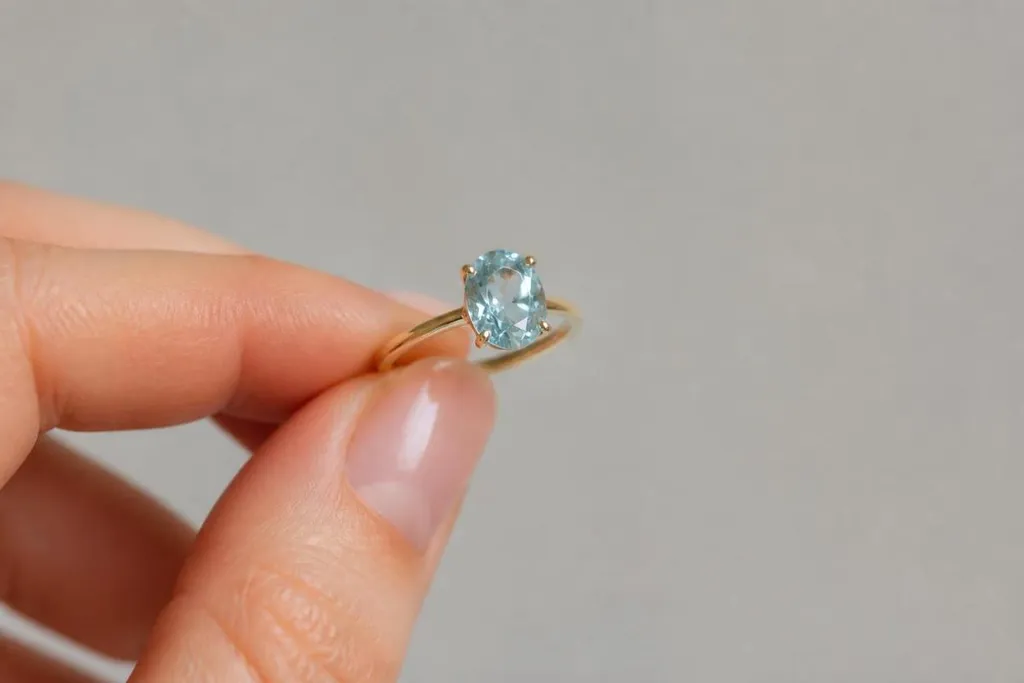
Aquamarine offers a different interpretation of blue in an engagement ring. Where sapphire tends towards deeper, more saturated colour, aquamarine is prized for its lighter blue tones and clear, airy appearance. The effect can be understated at first glance, yet a well-cut stone has enough colour and presence to make an engagement ring feel distinctly individual.
For couples drawn to a softer palette, timeless lab grown aquamarine engagement rings provide an elegant way to place pale blue at the centre of the design. Lab-grown aquamarine offers the essential chemical and crystal characteristics associated with aquamarine while fitting naturally into contemporary fine jewellery. Choosing the right ring involves considering how colour, cut, setting and metal work together, particularly because aquamarine's subtle tone responds strongly to its surroundings.
Understanding Aquamarine's Distinctive Blue
Aquamarine belongs to the beryl mineral family and is known for colour ranging from very pale blue to stronger blue and blue-green tones. Its name reflects its historic association with seawater, and that cool, translucent character remains central to its appeal.
With a pale gemstone, more colour is not necessarily better. Some wearers prefer a delicate icy blue because it creates a restrained engagement ring, while others want enough saturation for the stone to remain clearly blue in different lighting.
This makes viewing conditions important. Pale gemstones can respond noticeably to daylight, warm artificial light and the colours around them. The metal chosen for the ring can also affect how the aquamarine is perceived.
Rather than looking for the most intense stone available, it is more useful to choose a shade that retains the character the wearer finds appealing across everyday environments.
Cut and Size Can Give Aquamarine Presence
Aquamarine's clarity and lighter colour make the cut particularly influential. The shape determines both how the gemstone handles light and how much visual space it occupies on the finger.
Emerald-style cuts suit aquamarine especially well. Their broad step facets can emphasise the stone's clarity and produce a calm, architectural appearance. Oval cuts offer a softer alternative, providing elegant length and generous finger coverage.
Cushion shapes can create a more romantic look, while round cuts introduce familiar symmetry and can work beautifully in classic settings.
Carat weight needs context. Someone may choose a 2-carat aquamarine not simply because it is larger than a 1-carat stone, but because the increased surface area allows a pale blue colour to establish a stronger visual presence. Another wearer might prefer a smaller aquamarine surrounded by diamonds, using contrast rather than size to define the centre.
Proportion should ultimately suit the hand and the design rather than a predetermined carat target.
Choosing Metal and Accent Stones
Metal selection can noticeably alter an aquamarine engagement ring.
Platinum and white gold complement the gemstone's cool character, creating a crisp palette in which the blue can feel clean and luminous. This combination works particularly well for contemporary solitaires and diamond-set designs.
Yellow gold provides stronger contrast. The warmth of the metal can make the cool blue centre stone appear more pronounced while giving the overall ring a richer fine-jewellery character. Rose gold creates an even softer contrast and can lend aquamarine a romantic quality.
Colourless diamonds can also help define a pale centre stone. A halo creates a bright frame around the aquamarine, while diamond-set shoulders add sparkle without surrounding it completely. A trilogy design offers another option, using side stones to give the composition greater width and definition.
Think Carefully About Everyday Wear
Aquamarine ranks around 7.5 to 8 on the Mohs scale, making it reasonably hard but less resistant to scratching than sapphire or diamond. An aquamarine engagement ring can be worn regularly, but sensible care is important.
Removing the ring during heavy manual tasks reduces unnecessary risk of knocks and abrasion. A protective, well-designed setting can also be particularly valuable for someone with an active lifestyle.
Gentle cleaning helps prevent soaps, creams and everyday residue from reducing the gemstone's brightness. Periodic professional inspections are worthwhile too, allowing the security of claws and other setting components to be checked.
The profile of the engagement ring should also be considered alongside a future wedding band, especially if a close fit between the two is preferred.
Final Thought
Aquamarine engagement rings prove that a coloured centre stone does not need intense saturation to make an impression. Their appeal lies in clarity, soft blue colour and an elegance that can feel both contemporary and quietly romantic.
A thoughtfully chosen lab-grown aquamarine, paired with complementary metal and balanced proportions, creates presence without heaviness. For someone seeking an engagement ring that moves beyond conventional colour while remaining refined, aquamarine offers a particularly graceful alternative.